Monday, November 10, 2014

Saturday, October 4, 2014
Wednesday, August 6, 2014
Cooking Styles
I see cooks getting stuck on one piece of equipment. They will cut with the same type of knife or cook everything in the steamer. I actually saw someone wrap a pan of water in plastic wrap and put in the steamer. Seriously how hard is it boil water on stove that you have to heat it in the steamer. Why do people using a pairing knife for everything. That is why culinary school is important because is give you the fundamentals of different cooking styles and what knives to use for what jobs.
http://www.recipetips.com/kitchen-tips/t--1075/types-of-kitchen-knives.asp
http://www.recipetips.com/kitchen-tips/t--1075/types-of-kitchen-knives.asp
|
The following descriptions and images of different varieties of knives are general examples only. Although the basics of each knife style is the same, different manufacturers have different design variations for each type of knife.
Bird's Beak Knife | Boning Knife | Butter Knife | Ceramic KnifeCheese Knife | Chef's Knife | Chestnut Knife | Clam Knife | Cleaver Knife | Deli KnifeDevein Knife | Filet Knife | Frozen Food Knife | Grapefruit Knife | Mincing KnifeOyster Knife | Paring Knife | Sandwich Knife | Santoku Knife | Sashimi KnifeSerrated Knife | Slicing/Carving Knife | Steak Knife | Tomato Knife | Utility Knife
There are several things to consider when you are going to purchase knives, such as price, functionality, maintenance, and comfort. When purchasing knives, always purchase the best quality you can afford. Good quality knives will make the task of using them more efficient and they will last much longer than less expensive knives. When choosing knives, consider the tips below to ensure that you purchase the right knife for you.
Tips for Choosing the Right Knife:
|


Friday, July 11, 2014
Wednesday, July 9, 2014
proper cold holding
It's annoying when they put something on ice pile it high with product and then expect it too stay cold. Food only stays to the level of the ice.
http://wellnessmadenatural.com/2011/08/05/cooking-tip-thursdays-osmosis-in-the-kitchen/
http://www.state.in.us/isdh/files/Proper_Cooling_2014.pdf.
http://wellnessmadenatural.com/2011/08/05/cooking-tip-thursdays-osmosis-in-the-kitchen/
http://www.state.in.us/isdh/files/Proper_Cooling_2014.pdf.
Sunday, July 6, 2014
Knife skills.
I find knife skills define a cook. If you don't have the fundamentals of how to cut well I think its says something about the quality of your work. I have some cooks that when they rough cut vegetables some pieces are huge and other small. Beside that they will take different times to cook, some of the pieces obviously would not fit in a person mouth. I was always told to not cut anything larger than what would fit in a proper ladies mouth.
Good Article on Different types of cut. http://theculinarycook.com/knife-skills-different-types-of-cuts/
shown below.


Good Article on Different types of cut. http://theculinarycook.com/knife-skills-different-types-of-cuts/
shown below.
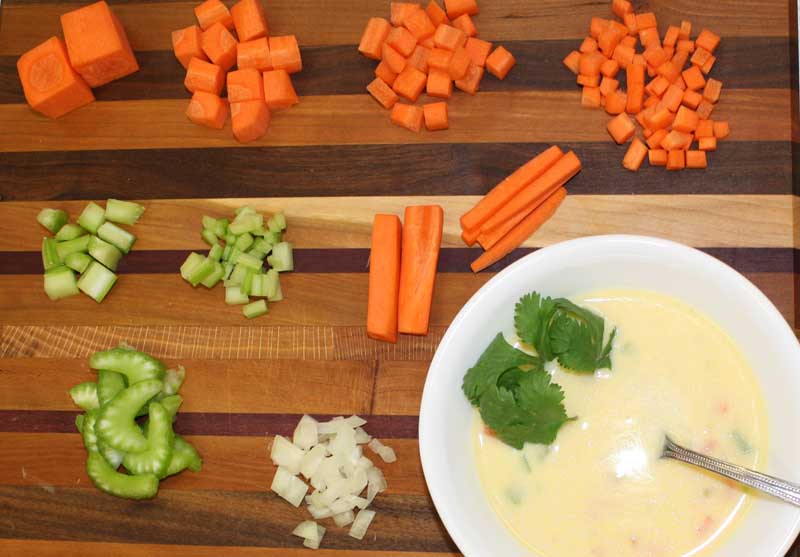
There are many different cutting types and while you may not use all of them, it’s important that you know and understand them. Having the knife skills and know-how to cut a brunoise, matchstick, or batonnet will not only help you improve your knife skills, but also improve the visual appeal and professionalism of the food you cook.
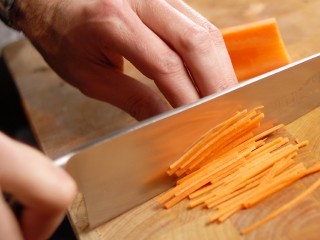
The Julienne Cut
If you’re like most people, you will likely chop your items as fast as possible without knowing or understanding why it’s important to cut properly. The first reason is uniformity. Take a carrot, for instance. It goes from very fat to very thin and most people will use a coin cut to slice it. This leaves very large and very small pieces in relation to itself. Why is this important? Well, large pieces take longer to cook (Especially when it comes to carrots). Uniformity in cutting ensures that you have even, predictable cooking times. Nobody wants carrots that are mushy and hard at the same time!
The second reason is aesthetics. Properly cut items look professional and have that visual appeal. Much of your appetite and the appetite of others stems from the visual appeal of your dish. The presentation is of the utmost important and a large percent of the satisfaction that people get from food comes from their eyes. People eat with their eyes, and it’s important to never forget that!
The Basic Types of Cuts
Taking into account that much of the reasoning behind the different cuts tie into the ability to cook accurately first, and aesthetically second is a foundational skill. Keeping these in mind will help you determine what type of cut is appropriate for the dish you are cooking and help you become a better cook. Obviously a diced carrot takes longer to cook than an equally sized dice of, say, celery. Using your knowledge, you will know that you will have to precook the carrots first before adding the celery!
Squaring Off Your Items

Squared-Off Carrot Segments
Before cutting an item, we’re going to learn how to square off the item you’re about to cook. The idea is to get the item to a stage that allows your cuts to be done uniformly. We will use the carrot as an example, as it is the most common abnormally shaped item you will be using. A lot of the skills you will learn will leave you with a bunch of waste. This is not as bad as you think! Once you get into the routine of making your own stocks you will learn that much of the waste will be transformed into delicious stocks. These techniques put form and perfection first. Many chefs and cooks will tell you this method produces TOO much waste. While it is true, remember that cutting and chopping has its own “Pick two of three” catch 22. This is:
Speed, Waste, Uniformity
If you want speed and low waste, you’ll lose uniformity.
If you want low waste and uniformity, you’ll lose speed.
If you want speed and uniformity, you’ll have more waste.
If you want low waste and uniformity, you’ll lose speed.
If you want speed and uniformity, you’ll have more waste.
Understanding these conditions, you will come to settle on a spot that is comfortable to you. Many industry professionals will settle somewhere in the middle.
Let’s get started on squaring off your carrot:
Start by peeling the carrot, removing the ends. Then, slice the carrot into segmented lengths of 4cm (2in.). Taking one of the segments, you will slice one end to produce a flat surface. This surface will then be laid flat, and you will continue the process for remaining sides. Your carrot segment will come out looking like a 3-dimensional rectangle. Now that you’ve squared off your carrot, you’re ready to start producing the type of cut you’re after.
The Julienne Cut
The julienne cut is a type of stick-shaped cut that is very thin. Cut from a squared off item, you will then slice that item length-wise at a thickness of 1-2mm (1/16 in) leaving you with thin rectangular cuts. Then, take the thin slices and apply the same technique. You will end up with Julienne (Or matchstick) cuts!
Dimensions: 2mm X 2mm X 4cm (1/16in X 1/16in X 2in)
Dimensions: 2mm X 2mm X 4cm (1/16in X 1/16in X 2in)
The Brunoise Dice
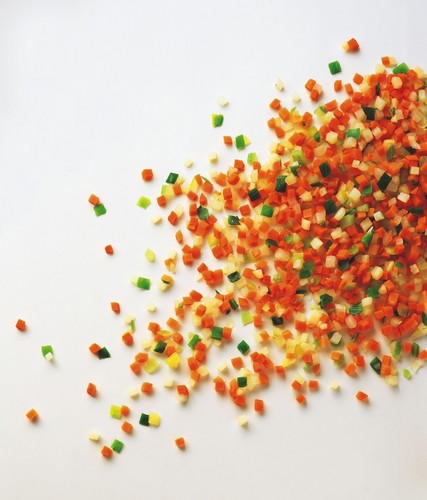
The Brunoise Dice
The Brunoise dice is the smallest dice you can have. While you can mince to a smaller dimension, this method refers to the smallest uniform size available for dicing. This method is simple and only adds an additional step to the Julienne method. Take your julienne cuts and bunch them up with your hand. Then cut the julienne into equally shaped dice. That’s it! While simple, it does take a long time to master. Get crackin’!
Dimensions: 2mm X 2mm X 2mm (1/16 in X 1/16 in X 1/16 in)
Dimensions: 2mm X 2mm X 2mm (1/16 in X 1/16 in X 1/16 in)
The Small Dice
The small dice is similar to the brunoise, but it is slightly larger. Start by following the steps to Julienne your item. You want to slice your squared-off item at a thickness of 3mm. Now it’s only a matter of finishing off the dice as you would the Brunoise!
Dimensions: 3mm X 3mm X 3mm (1/8 in X 1/8 in X 1/8 in)
Dimensions: 3mm X 3mm X 3mm (1/8 in X 1/8 in X 1/8 in)
The Batonnet
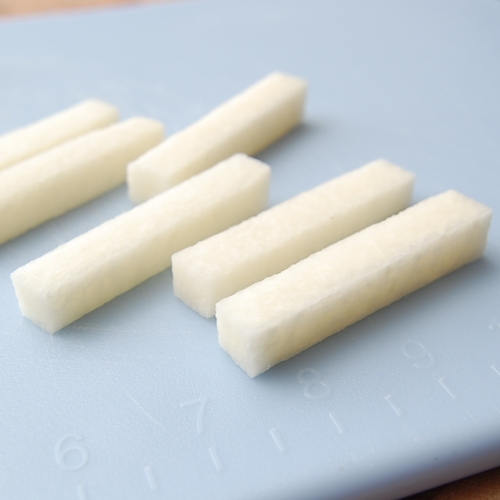
The Batonnet Cut
You’re probably starting to notice a pattern here. We start with squaring off our item, slicing it to the thickness desires, and then going from there. The batonnet is no different, but what the purpose of knowing these cuts are they are standard sizes that you’ll see in most professional recipes as well as recipes posted on TheCulinaryCook. Let’s continue. The Batonnet is no different, and we are aiming for a larger stick-cut. The batonnet is used when serving a larger potion of an item such as a vegetable side, to gain height in your dish, or to provide imposing linear appeal to an otherwise linear-absent dish.
Dimensions: 6mm X 6mm X 6cm (1/4 in X 1/4 in X 2 in)
Dimensions: 6mm X 6mm X 6cm (1/4 in X 1/4 in X 2 in)
The Medium Dice
The medium dice is derived from the Batonnet and the only added step is slicing the batonnet to produce cubes. This size is called a Medium Dice.
Dimensions: 6mm X 6mm X 6mm (1/4 in X 1/4 in X 1/4 in)
Dimensions: 6mm X 6mm X 6mm (1/4 in X 1/4 in X 1/4 in)
The Baton
The baton is the largest stick-cut you can cut. It is used for crudites and for presentation purposes. While not used as much as the rest, it is the foundation for the more common Large Dice.
Dimensions: 12mm X 12mm X 6cm (1/2 in X 1/2 in X 2-1/2 in)
Dimensions: 12mm X 12mm X 6cm (1/2 in X 1/2 in X 2-1/2 in)

A Large Dice Cut
The Large Dice
The large dice is primarily used for stews, long-cooking dishes and for mirepoix in stocks. The large dice is important, because it is relatively quick, has a great imposing nature and looks professional. When cutting a large dice, you will tend to have a higher waste when trying to get nicely cut pieces using the method describing how to square off your item. Remember when doing any cutting or dicing to use the method best suited for your dish.
Dimensions: 12mm X 12mm X 12mm (1/2 in X 1/2 in X 1/2 in).
Dimensions: 12mm X 12mm X 12mm (1/2 in X 1/2 in X 1/2 in).
The Paysanne Cut
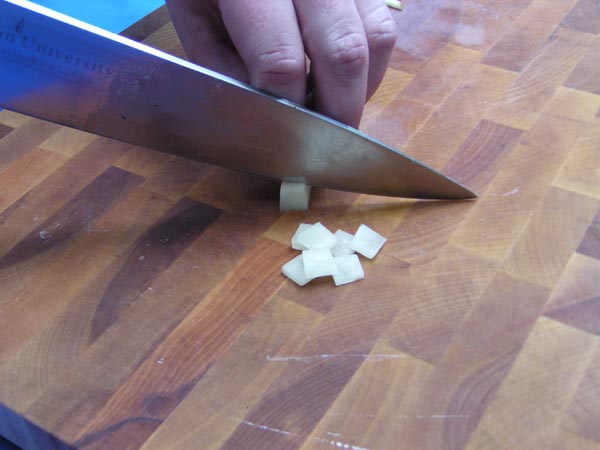
A Paysanne Cut
The paysanne cut is included here to show you that while cubed items are common, sometimes you would prefer a slimmer, flat, square item. This is called the Paysanne. This is achieved by creating your desired stick-cut size, then slicing thinly to produce a thin square. Typically used for larger cuts, this method can be applied to smaller cuts and dices as well.
Dimensions: 12mm X 12mm X 3mm (1/2 in X 1/2 in X 1/8 in)
Dimensions: 12mm X 12mm X 3mm (1/2 in X 1/2 in X 1/8 in)
There are different types of cuts that you can use as well.
The Chiffonade
The chiffonade is used when slicing very thin items such as herbs or leaf vegetables such as spinach. Cutting en chiffonade is a really simple process. Start by stacking the items you are looking to slice. Then roll up the items, producing a cigar-shaped roll. Once it’s rolled, start slicing to produce a nice chiffonade suitable for garnishing and other purposes.
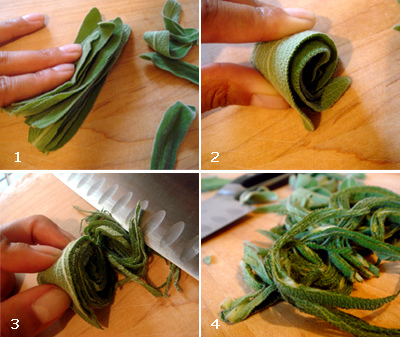
The Chiffonade Method, photo by Flickr user Lifeflix
These are the knife skills you can practice with and get an good understanding of. Once masted, you can move onto more advanced methods of cutting, slicing and dicing including butterflying, deboning, carving, and working with difficult objects.
Results come from practice, so get out there and start practicing your knife skills!
Wednesday, July 2, 2014
Everything, But ...
We do a cook station in the cafeteria a few days a week. Maybe a salad or stir-fry, etc with 4 or five choices. People will say everything but and proceed to list everything except maybe one items. For example, chicken Caesar salad everything but no tomato, black olives, onions where the only ingredient they wanted was parmesan cheese.
I would think just saying what you want would be easier in that type of situation and less chance for errors. It could be laziest or poor grammar or maybe it just never occurred to them.
Just like the example below and why people use very.

I would think just saying what you want would be easier in that type of situation and less chance for errors. It could be laziest or poor grammar or maybe it just never occurred to them.
Just like the example below and why people use very.

Time Management
Anything worth doing is worth doing right.
If you do the right things adequately, that's muchmore important than doing the wrong things beautifully
http://en.wikiquote.org/wiki/Randy_Pausch
If you do the right things adequately, that's muchmore important than doing the wrong things beautifully
http://en.wikiquote.org/wiki/Randy_Pausch
Friday, May 30, 2014
In the Weeds.
A perfect example of this would be today. The truck delivery was 3 hours late, I had to do all the cooking for the cafeteria, assist a supervisor with some health department paperwork, while also managing the kitchen. I like it when someone ask if you need help and they really want you to say no and when you say yes and you give them something to do. They usually do it quickly or not at all and then disappear.
Reminds me of one the supervisors who just wanders through the kitchen asking everyone how they are doing? Just like a good restaurant server know what you need before you ask. A good supervisor should be aware of what going on in the kitchen/cafeteria and step in and help when necessary.
Reminds me of one the supervisors who just wanders through the kitchen asking everyone how they are doing? Just like a good restaurant server know what you need before you ask. A good supervisor should be aware of what going on in the kitchen/cafeteria and step in and help when necessary.
Wednesday, May 28, 2014
Mise En Place
(From Wikipedia, the free encyclopedia
Mise en place (French pronunciation: [mi zɑ̃ ˈplas]) is a French phrase which means "putting in place", as in set up. It is used in professional kitchens to refer to organizing and arranging the ingredients (e.g., cuts of meat, relishes, sauces, par-cooked items, spices, freshly chopped vegetables, and other components) that a cook will require for the menu items that are expected to be prepared during a shift)
Someone once asked me about how cooks get in the weeds and why sometimes new cooks struggle.
The Urban Dictionary defines “in the weeds” as:
“When someone or something, usually in the food or beverage industry, becomes overwhelmed and falls behind.” Such as: “Hey chef, can you plate up those two fish for me?? I’m in the weeds….”
One of the cardinal rules is if your mise en place is done you should be able to handle anything, hopefully. But if two many tables are seated at once or orders are properly spaced, or a number of things the kitchen will get behind. All food cooks at its own speed and it is the kitchen responsibility to make sure all of the food for a table is finished at the same time. If something is off the whole table orders might have to be re cooked. Communication is key, most cooks are working three to four orders ahead keeping all the completion times in the head. Constantly prioritizing and thinking about what to do next.
interesting blog about in the weeds.http://harvestamericacues.com/2014/04/26/cooks-in-the-weeds-gasping-for-air/
Thursday, May 8, 2014
Pet Peeves
What really disgust me is when I see people coming out the bathroom with their apron still on. I really hate seeing people walking the halls with disposable gloves on. Their disposable, throw them out when you leave the kitchen. Then I don't have to worry that you put new gloves when you get back to your station.
I don't work in surgery or on the floors but why would go outside to the curb to smoke in full dress (ie. mask, shoe covers, gown, etc.) Isn't that equipment supposed to reduce contamination which now have smoke all over it.
Respect - I find it disrespectful to food to overcook it or mishandle food. I think one of the cornerstones of cooking should be respect for the ingredients. A perfect example would be were a cook instead of shocking pasta correctly just threw some ice on it a put in the cooler. That is wrong on so many levels, from sanitation to extremely water logging the pasta. How long would it have taken to rinse the pasta under cold water, it's this laziness which gives hospital food its reputation.
I don't know why people don't like to measure ingredients. If you measure everything every time you don't have to worry about having inconsistent product. For example our mashed potatoes at work one box mashed potatoes to 2 gallons of water. The cooks you just pour water in a bowl and have to spend time adding mix and then repeatedly until the get the right consistency. If you measured the water their would be no guess work involved.
It's funny the same people who never have time to help are the same people I catch chatting all the time.
Storage order- What is so difficult about raw products below cooked that is so difficult to remember. It is a little more complex than that but they can't even remember that.

Not really a pet peeve, but definitely words to live by.
I don't work in surgery or on the floors but why would go outside to the curb to smoke in full dress (ie. mask, shoe covers, gown, etc.) Isn't that equipment supposed to reduce contamination which now have smoke all over it.
Respect - I find it disrespectful to food to overcook it or mishandle food. I think one of the cornerstones of cooking should be respect for the ingredients. A perfect example would be were a cook instead of shocking pasta correctly just threw some ice on it a put in the cooler. That is wrong on so many levels, from sanitation to extremely water logging the pasta. How long would it have taken to rinse the pasta under cold water, it's this laziness which gives hospital food its reputation.
I don't know why people don't like to measure ingredients. If you measure everything every time you don't have to worry about having inconsistent product. For example our mashed potatoes at work one box mashed potatoes to 2 gallons of water. The cooks you just pour water in a bowl and have to spend time adding mix and then repeatedly until the get the right consistency. If you measured the water their would be no guess work involved.
It's funny the same people who never have time to help are the same people I catch chatting all the time.
Storage order- What is so difficult about raw products below cooked that is so difficult to remember. It is a little more complex than that but they can't even remember that.

Not really a pet peeve, but definitely words to live by.
- He said, when you’re screwing up and nobody’s saying anything to you anymore, that means they gave up. And that’s a lesson that stuck with me my whole life. Is that when you see yourself doing something badly and nobody’s bothering to tell you anymore, that’s a very bad place to be. Your critics are your ones telling you they still love you and care.
- When Pausch spoke of "when you’re screwing up and nobody’s saying anything to you anymore, that means they gaveup." he was quoting an assistant coach of football coach James Graham
Wednesday, April 23, 2014
Busy Day
Two calls in at work.
<Sarcastic Font> Pro tip to boiling eggs seen at work today. Boil eggs until all water evaporates.
What is up with all the people wearing headphones at work in one ear. You have to tell them everything twice. Once so they hear you and take out headphone and then another to tell what you want. Not to mention when working in a kitchen they are constantly contaminating their hands touching their phone/ headphones, etc.
<Sarcastic Font> Pro tip to boiling eggs seen at work today. Boil eggs until all water evaporates.
What is up with all the people wearing headphones at work in one ear. You have to tell them everything twice. Once so they hear you and take out headphone and then another to tell what you want. Not to mention when working in a kitchen they are constantly contaminating their hands touching their phone/ headphones, etc.
Friday, April 18, 2014
Subscribe to:
Comments (Atom)